DQE Seal

Department of Questionable Engineering

DQE • doqe.org
HomeInventions › Microservice Pencil Sharpener

Microservice Pencil Sharpener

All the reliability of a pencil sharpener, mediated by a federation of twelve single-purpose services.

Patent Pending — DQE-MPS-2026-603
← All Inventions
Microservice Pencil Sharpener — official prototype photograph
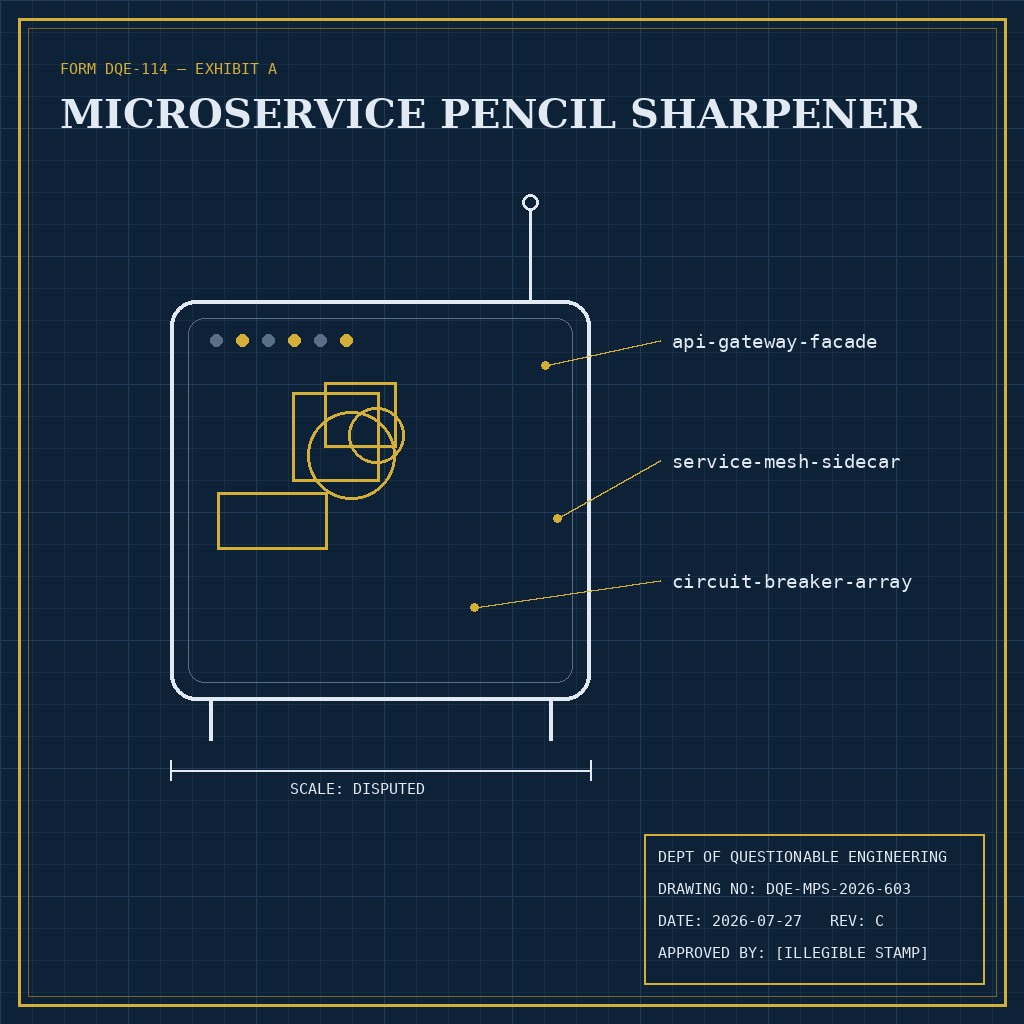
Fig. 1 — Microservice Pencil Sharpener, as entered into the Departmental Register. Scale disputed.

The Microservice Pencil Sharpener reimagines sharpening pencils as a federation of twelve single-purpose services. What was once a thoughtless household action is now a fully governed workflow with audit trails, quarterly reviews, and a dedicated on-call rotation.

Operation begins by filing a PointRestoration, which enters a priority queue ordered by seniority. Note that operators must coordinate twelve independent deployments to change one setting — a requirement introduced after Incident 47, about which no further questions are taken.

Architecture

  • api-gateway-facade: Validates every incoming PointRestoration against policy; rejections are final but appealable in writing.
  • service-mesh-sidecar: Coordinates the 21-component control plane; quorum required for all state changes.
  • circuit-breaker-array: Publishes health status to 7,865 telemetry series and a wall-mounted dashboard no one watches.

Operational Characteristics

  • Disaster recovery: full state restoration in under 46 hours, assuming the runbook can be located
  • Emits 7,865 distinct telemetry series; three are believed to be meaningful
  • Steady-state availability: 99.91% (excluding scheduled ceremonies, unscheduled ceremonies, and Tuesdays)
  • P50 time-to-outcome: 4 min; P99: 28 min — a 9,901% governance premium over the legacy device, well within tolerance

Comparison to Legacy Pencil Sharpener

  • Legacy pencil sharpener: insert pencil, twist, done
  • Microservice Pencil Sharpener: file a PointRestoration, pass policy validation, coordinate twelve independent deployments to change one setting, await scheduling, receive outcome; 4 min–28 min typical

  • Improvement: complete auditability, a striking architecture diagram, and the quiet confidence that nothing happens by accident anymore